
What is the Best Metal Gauge for Driveway Gates? (Why We Use 7 Gauge)
When you are shopping for a custom driveway gate, most companies will talk about design and color. But there is one technical spec they usually hide in the fine print: The Gauge (or gage) Thickness of the steel.
The gauge of the metal is the single most important factor in how long your gate will last. At JDR Metal Art, we build our gates using heavy-duty 7 Gauge Steel.
Here is why that number matters, and why you should avoid the industry standard of 11 or 14 gauge.
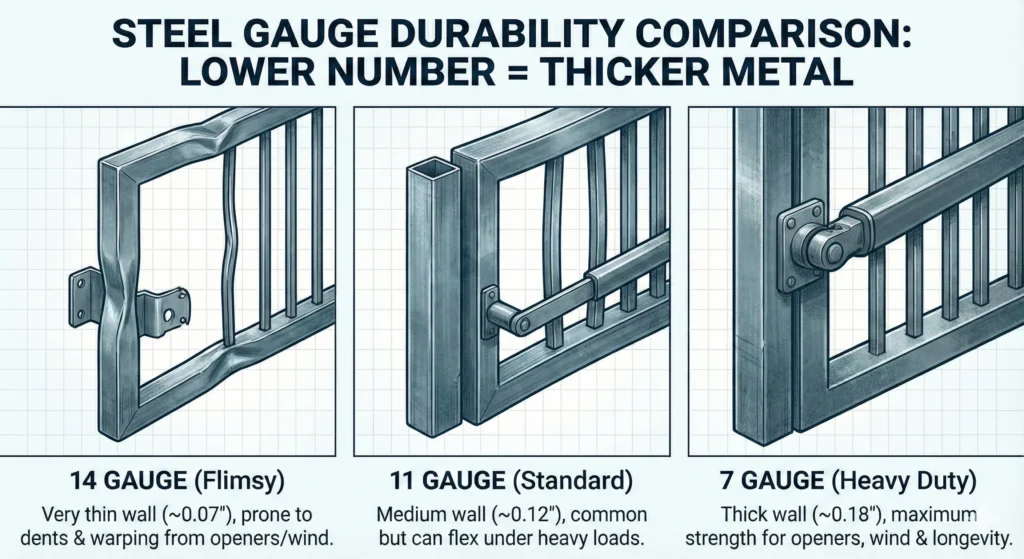
Understanding Metal Gauge: Lower is Thicker
The steel gauge system works backward: the smaller the number, the thicker the metal.
14 Gauge: Very thin (~0.07 inches). Common in cheap, mass-produced fence panels.
11 Gauge: The “Industry Standard” (~0.12 inches). Used by most custom gate builders.
7 Gauge: Heavy Duty (~0.18 inches). Used by JDR Metal Art.
The Problem with Thinner Gates (11ga and 14ga)
Most competitors use 11 gauge or 14 gauge tubing because it is cheaper to buy and lighter to ship. However, driveway gates periodically face massive stresses that these thinner metals cannot handle long-term.
1. The “Gate Opener” Torque Automatic gate openers attach to a single point on your gate and push/pull with tremendous force.
On a thin 14ga gate: Over time, the constant pushing and pulling creates metal fatigue at the attachment bracket. Eventually, the steel tears like a soda can.
On our 7ga gate: The steel is thick enough to withstand the torque of the opener without flexing or tearing, even after thousands of cycles.
2. Wind Load A solid or semi-private gate acts like a giant sail. In high winds, a 14-foot gate can experience hundreds of pounds of force. Thin metal frames will twist, warp, or “bow” under this pressure, ruining the alignment of your latch. Our 7 gauge frames are rigid enough to stand their ground in high-wind storms.
3. Impact Resistance Life happens. A lawnmower bumps the frame, a delivery driver backs up too close, or a bike hits the gate.
14 Gauge: Dents easily, and once powder coat is chipped and the metal is dented, rust begins immediately.
7 Gauge: Is structurally robust. It takes significantly more force to dent 7 gauge steel, keeping your gate looking new for decades.
The JDR Metal Art Difference
We don’t build “disposable” gates. We build legacy pieces. By using 7 gauge steel for our structural components, we ensure that your gate is:
Too strong to sag and warp under its own weight.
Too rigid to twist in the wind.
Heavy enough to feel substantial and secure.
If you want a gate that you only have to buy once, check the specs. If it isn’t 7 gauge, ask yourself why.